Business Analyst

When everyone in the company can ask questions about your data

Understand rapid decision-making with data democratisation. Discover how instant data access transforms operations, boosts productivity, and nurtures a culture of innovation in your organisation.


When everyone in the company can ask questions about your data

Part 2 of 5: Closing the Data Gap

A finance director walks into a board meeting with updated margin figures printed five minutes earlier. A sales manager reviews pipeline conversion rates between calls. An operations lead investigates a delivery delay the same afternoon it happens.

These scenarios describe what becomes possible when the three-day wait for data disappears. When anyone in an organisation can ask a question in plain English and receive an accurate answer within seconds, the relationship between information and action changes fundamentally.

Companies using systems like the Xcelerate Business Analyst report measurable shifts in how teams work, how quickly decisions happen, and how widely data influences daily operations. It is theory in practice. `

Request a live demo of the Xcelerate Business Assistant

What this looks like in practice

The employee's experience (i.e. finance director/sales manager/operations lead) is straightforward: a user opens an interface, either through a web dashboard or a messaging platform like Slack or Teams, and types a question in ordinary language.

The system translates the question into a database query, retrieves the relevant information from the company's data warehouse, and returns an answer that includes the figure, its source, and when the data was last updated.

The user can ask follow-up questions immediately. If the initial answer raises additional questions, those can be posed in the same conversation without starting a new request or waiting for someone else to process it. This conversational approach mirrors how people naturally think through problems, moving from one question to the next as understanding deepens.

Research on data democratisation confirms that this approach accelerates decision-making processes substantially. In traditional setups, employees had to wait for specialised data teams to pull, analyse, and present data. Direct access removes that dependency entirely.

1. Finance: From monthly reports to instant know-it-all

A finance director preparing for a quarterly review needs to compare revenue across three business units for the past six months. In a traditional setup, this request would go to an analyst, who would pull data from the financial system, clean it, format it, and return a spreadsheet within a day or two.

With direct data access, the director types: "Show me revenue by business unit for the last six months." The system returns a table with the figures, sourced from the financial database, with the last update timestamp visible. The director notices one unit's revenue dropped in April and immediately asks: "What caused the revenue drop in Unit B during April?" The system identifies reduced transaction volume in that unit's primary service line and provides the breakdown.

The entire exchange takes less than two minutes. The director enters the meeting with current information and an understanding of the underlying cause, which allows for a more informed discussion about corrective measures.

The necessary data integration that data democratisation requires reduces data bottlenecks, enabling business users to make faster business decisions and freeing up technical users to prioritise tasks that better utilise their skillsets.

2. Sales: Real-time pipeline visibility

A sales manager wants to understand why conversion rates dropped this quarter compared to last. Rather than submitting a request to the operations team and waiting for a report, the manager asks the system directly: "Compare deal conversion rates between Q4 2024 and Q1 2025."

The system returns the figures: 34% in Q4, 28% in Q1. The manager follows up: "What changed in our deal stages between those quarters?" The system identifies that deals are stalling longer in the proposal stage, with an average of 12 additional days compared to Q4.

Armed with this information, the manager can address the bottleneck immediately, whether that means adjusting sales training, revising proposal templates, or reallocating resources to move deals through that stage faster. The insight leads to action the same day, rather than weeks later after formal analysis has been completed.

3. Operations: Same-day root cause analysis

An operations manager notices customer complaints increasing over the past week. Instead of waiting for a weekly report or asking the data team to investigate, the manager queries the system: "Show me customer complaint volume over the past 30 days."

The system displays a chart showing a sharp increase starting eight days ago. The manager asks: "What types of complaints increased?" The system breaks down the complaints by category and identifies delivery delays as the primary driver.

The manager continues: "Which delivery routes show the highest delay rates?" The system identifies two specific routes experiencing unusually long transit times. The manager can now investigate those routes specifically, contact the logistics provider, and address the issue before it compounds further.

This type of investigation, which would typically require multiple people and several days, happens in a single afternoon. The faster the organisation can identify and respond to operational issues, the less impact those issues have on customers and revenue.

4. Marketing: Campaign performance without the wait

A marketing lead launching a new campaign across three channels wants to compare early performance to determine where to allocate additional budget. Rather than waiting for the monthly marketing report, the lead asks: "Show me cost per acquisition by channel for the current campaign."

The system returns figures for email, social media, and search advertising. Email shows a CPA of AED 165, social media AED 286, and search AED 228. The lead immediately follows up: "What was our target CPA for this campaign?" The system confirms the target was AED 184.

With this information, the marketing lead can shift budget toward email, which is performing well below target, and investigate why social media costs are higher than planned. These adjustments happen within the campaign's active period, rather than after it concludes, which improves overall return on investment.

5. HR: Workforce planning based on current data

An HR manager preparing headcount forecasts for the next quarter needs to understand current staffing levels and recent turnover patterns. The manager asks: "What is our current headcount by department?" The system provides the breakdown.

The manager follows up: "What was our staff turnover rate over the past six months?" The system calculates the figure and identifies which departments experienced the highest turnover. The manager can then ask: "How long does it take on average to fill open positions in those departments?" and receive data on hiring velocity.

This information allows the HR manager to build more accurate forecasts and identify where recruitment efforts need to intensify. Decisions about hiring timelines, budget allocation, and resource planning become grounded in current reality rather than outdated assumptions.

What changes across the organisation

When data access moves from a centralised queue to a self-service model, several positive changes occur simultaneously.

Decision speed increases measurably

Companies with strong data cultures make decisions five times faster than those without. This is not because people think faster, but because they spend less time waiting for information. When a question arises during a meeting, it can be answered before the meeting ends. When a trend appears in weekly performance, it can be investigated the same day rather than added to a backlog.

Analysts shift focus to complex work

When routine questions can be answered directly by the people asking them, data analysts and BI specialists spend less time fielding ad hoc requests. Research shows that systems like the Business Analyst reduce these requests by 60 to 80 per cent, which frees analysts to work on deeper analysis, predictive modelling, and projects that require specialist expertise.

Data adoption expands significantly

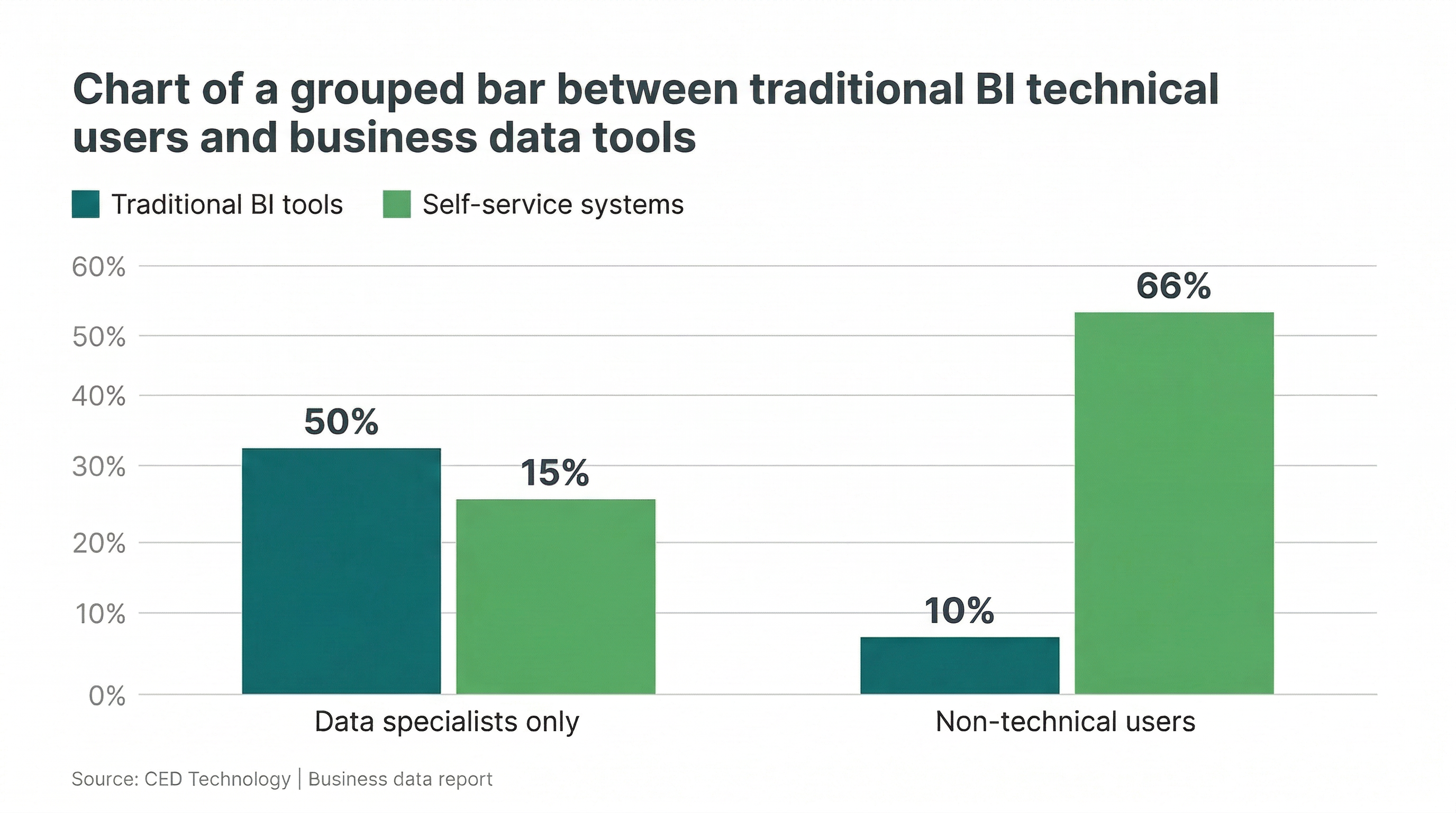
Over 65% of companies are adopting self-service BI platforms to eliminate reliance on IT teams and gain faster access to actionable insights. When data becomes accessible to non-technical users, more people use it. Companies implementing these systems report approximately three times more employees accessing data directly compared to traditional models.

Companies implementing self-service embedded analytics see 41% higher feature adoption rates, indicates that when tools are designed for broad use rather than specialist use, people actually engage with them.

Questions lead to better questions

One of the less obvious but important changes is that access to data encourages curiosity. When answering a question takes three days, people learn to ask fewer questions. When answers arrive in seconds, follow-up questions become natural.

A finance director who can quickly see that revenue dropped does not stop there. They ask why it dropped, which products or regions contributed, and whether the pattern appears elsewhere. This iterative questioning leads to deeper understanding and more informed decisions.

The compound effect on organisational performance

The impact of faster data access compounds over time. Individual decisions improve because they are based on current information rather than estimates or outdated reports. Teams align more effectively because everyone works from the same verified figures. Strategic planning becomes more responsive because leaders can test assumptions quickly rather than waiting for quarterly reviews.

Data-driven organisations are 23 times more likely to acquire customers, six times as likely to retain customers, and 19 times more likely to be profitable. These multiples reflect not just better technology, but a fundamental shift in how organisations operate when information flows freely.

Companies that employ data-driven decision-making increase their operation's productivity rate to 63%, a figure that reflects both faster decisions and better resource allocation across teams.

What this means for organisational culture

Beyond the operational improvements, direct data access changes how people think about their work. When data is locked behind specialists, it becomes something separate from daily operations. When it is accessible, it becomes part of how decisions naturally happen.

Data democratisation empowers organisations by granting employees access to data, accelerating decision-making, and nurturing a culture of innovation. Teams begin proposing solutions based on patterns they observe in the data rather than waiting for formal analysis to validate their instincts.

This positive effect of having a business data assistant that can answer a technical data question in an instant, does not happen immediately. It requires people to trust that the data they are accessing is accurate, that they are interpreting it correctly, and that their conclusions will be taken seriously. But when those conditions are met, the result is an organisation where evidence informs decisions at every level, not just in the executive suite.

What comes next

This article has focused on the outcomes, what changes when data becomes accessible to everyone who needs it. The next article in this series examines how this actually works technically, explaining the infrastructure that makes instant, accurate answers possible while maintaining security and governance.

The Xcelerate Business Analyst achieves these results by connecting to existing data systems, applying consistent metric definitions, and translating plain English questions into precise database queries. The technology exists and is being used now. Understanding how it functions helps clarify what is required to implement it.

Learn more about data and reporting

Sources

Similar posts

Get notified on new marketing insights

Be the first to know about new B2B SaaS Marketing insights to build or refine your marketing function with the tools and knowledge of today’s industry.