How to implement conversational data access: From metrics dictionary to live system
Part 5 of 5: Closing the Data Gap
This is the final article in a series that began with a simple revenue question that takes three days to answer. The first article established the problem: business questions get stuck waiting for analysts. The second explored what changes when everyone can ask questions about data. The third explained the infrastructure behind instant answers. The fourth showed what this looks like in practice across five business functions.
This final article addresses the implementation process. What does it take to build a system that answers business questions in seconds? Where do companies start? How long does it take to see value? What are the common obstacles, and how do successful implementations navigate them?
The answer is neither simple nor prohibitively complex. Building conversational data access requires deliberate work, but most mid-sized organisations already have many of the necessary foundations in place. The question is not whether it can be done, but whether the organisation is willing to invest the time and resources to do it properly.
What you need before you begin implementation
Not every organisation is ready to implement conversational data access. The technology exists, but the foundation must be solid enough to support it.

Centralised data storage
The system works by querying a data warehouse where business information is stored in structured formats. If company data exists primarily in disconnected spreadsheets, local databases, and individual file systems, that data must be consolidated first.
This does not mean every system must feed into one platform immediately, but establishing a central repository where key business metrics can be reliably calculated. For most mid-sized companies, this involves connecting their ERP system, CRM platform, and financial software to a warehouse like Snowflake, Google BigQuery, or Amazon Redshift.
Companies with documented data governance reduce analytics rework by 62% and cut time-to-insight by 40% (SR Analytics, 2025). The consolidation work delivers value even before conversational data access gets implemented, because it improves the reliability of all reporting systems.
Agreed metric definitions
When someone asks "What was our revenue last month?", the system must know which transactions to include, which to exclude, and how to calculate the figure. This requires documented definitions for every metric the system will answer questions about.
Most organisations have these definitions somewhere, often scattered across different documents, systems, or in the heads of specific employees. Implementation requires gathering these definitions, resolving inconsistencies, and documenting them in a structured format.
A finance team might define revenue as invoiced amounts minus refunds and adjustments, recognised on the invoice date. A sales team might define it as closed deals regardless of invoicing status. The semantic layer forces these teams to agree on one definition, which then applies consistently across all queries.
Research indicates that 56% of organisations rate data quality as their biggest integrity challenge, with data governance close behind at 54% (ElectroIQ, 2025). Addressing these issues upfront prevents the system from amplifying inconsistencies later.
Executive sponsorship
Technical implementation requires a solid budget, staff time, and sometimes external expertise. More importantly, it requires the authority to make decisions about metric definitions, data access permissions, and system priorities.
Executive support and data governance maturity are crucial success factors that directly affect implementation speed (LARK InfoLab, 2026). Without senior leadership commitment, projects stall when departments disagree about definitions or when competing priorities emerge.
The sponsor does not need to understand the technical architecture, but they must understand why the project matters and be willing to resolve disputes when they arise.
Realistic expectations about timelines
Most organisations achieve satisfactory returns from AI implementations within 2 to 4 years, which is 3 to 4 times longer than conventional technology deployments (Master of Code, 2026). However, ROI can be demonstrated in 90 days if proper foundations are already in place (SR Analytics, 2025).
The difference comes down to preparation. Companies with clean data, documented metrics, and strong governance see value quickly. Companies that need to address these prerequisites first should expect longer timelines before conversational data access becomes useful.
Where to start: The metrics dictionary
The simplest starting point is a metrics dictionary. This is not a complex technical artifact. It is a documented list of the business questions the organisation wants to answer, along with the definitions required to answer them.
A basic metrics dictionary might include:
Revenue
- Definition: Total invoiced amount minus refunds and adjustments
- Source: ERP system, invoices table
- Calculation: SUM(invoice_amount) - SUM(refunds) - SUM(adjustments)
- Filters: Invoice date, business unit, product line
- Owner: Finance director
Active customers
- Definition: Customers with at least one transaction in the past 90 days
- Source: CRM system, transactions table
- Calculation: COUNT(DISTINCT customer_id) WHERE transaction_date >= TODAY() - 90
- Filters: Region, customer segment
- Owner: Sales director
Gross margin
- Definition: (Revenue - Cost of goods sold) / Revenue
- Source: ERP system, invoices and costs tables
- Calculation: (SUM(revenue) - SUM(COGS)) / SUM(revenue)
- Filters: Product line, time period
- Owner: Finance director
This dictionary serves two purposes. First, it forces the organisation to agree on definitions before building the system. Second, it provides the foundation for the semantic layer that the system will use to translate questions into queries.
Creating the initial dictionary typically takes 2 to 4 weeks for a mid-sized organisation. This involves interviewing department heads, reviewing existing reports, identifying the 20 to 30 most frequently asked questions, and documenting how each should be calculated.
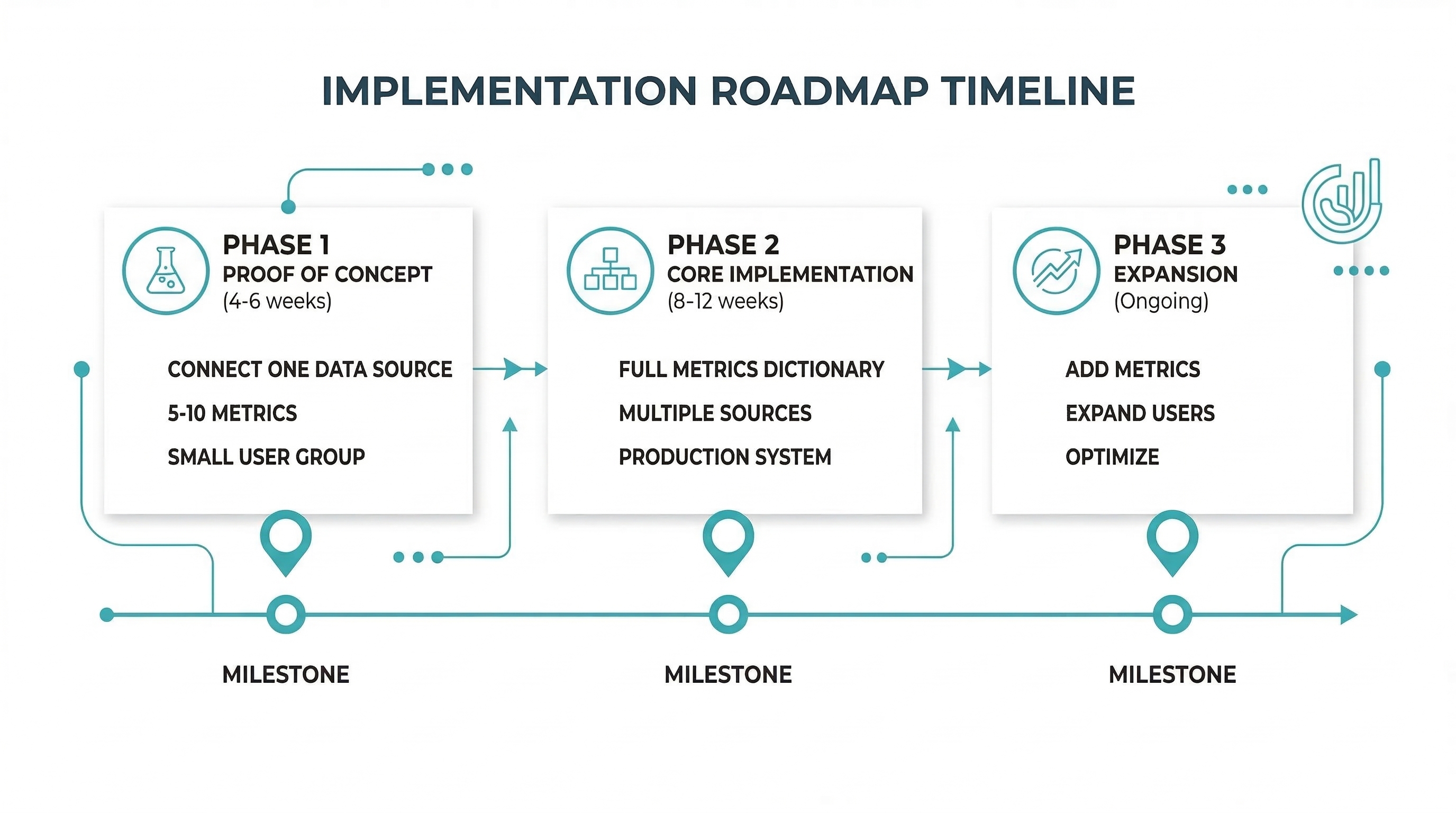
The implementation roadmap
Once the prerequisites are in place, implementation follows a predictable sequence.
Phase 1: Proof of concept (4 to 6 weeks)
The first phase demonstrates that the system can answer a small set of questions accurately. This typically involves:
- Connecting to one data source (usually the data warehouse)
- Implementing 5 to 10 metrics from the dictionary
- Setting up basic security and permissions
- Testing with a small group of users (usually finance or operations)
The goal is not to build a production system, but to prove that the approach works with the organisation's actual data. Success means users can ask questions like "What was revenue last month?" and receive accurate, sourced answers within seconds.
Research shows that 70% to 85% of AI projects fail to meet expected outcomes (Promethium, 2025). Many failures occur because organisations skip the proof of concept phase and build full systems before validating that the technology works with their specific data and use cases.
Phase 2: Core implementation (8 to 12 weeks)
After validating the concept, the second phase expands the system to production readiness. This involves:
- Implementing the full metrics dictionary (typically 30 to 50 metrics initially)
- Connecting to additional data sources (CRM, ERP, other systems)
- Establishing comprehensive security and audit logging
- Building the user interface (web dashboard, Slack integration, or both)
- Training the initial user group
At the end of this phase, the system can answer the majority of routine business questions across multiple departments. Users have been trained, documentation exists, and the system operates reliably.
Phase 3: Expansion and adoption (ongoing)
The third phase focuses on increasing usage and adding capabilities. This involves:
- Adding more metrics based on user requests
- Expanding to additional departments or business units
- Refining definitions based on real usage patterns
- Optimising performance and response times
- Measuring impact and documenting value
This phase does not have a fixed end date. The system grows as the organisation's needs evolve. New metrics get added when new questions become important. Existing definitions get refined when inconsistencies surface.
Organisations implementing well-structured BI initiatives see a 30% increase in operational efficiency (Gartner via SR Analytics, 2026). These gains accumulate as more people use the system and as usage patterns inform further improvements.
Common obstacles and how to address them
Every implementation encounters resistance. The obstacles are predictable, and so are the solutions.
"Our data is not clean enough"
This objection appears in nearly every project. The concern is legitimate. If underlying data contains errors, the system will surface those errors more quickly than traditional reporting methods.
The solution is not to delay implementation until data is perfect. Perfect data does not exist. The solution is to start with metrics where data quality is already acceptable, document known limitations, and use increased visibility to drive data quality improvements.
When more people access data directly, quality issues that were previously invisible become obvious. This creates pressure to fix them. 56% of organisations cite data quality as their biggest integrity challenge (ElectroIQ, 2025), but visibility is the first step toward improvement.
"We do not have time for this"
Cultural resistance represents the dominant barrier to data transformation, yet companies allocate only 10% of transformation budgets to change management (Integrate.io, 2026).
Teams that spend significant time answering ad hoc questions often resist implementing systems that would reduce that workload, because the upfront effort feels like additional burden on top of existing responsibilities.
The solution is to start small with one or two departments that see clear value and have capacity to participate. Success with early adopters creates momentum and demonstrates ROI to sceptical teams.
"Users will not trust AI-generated answers"
This concern is valid. Data trust is the number one concern around AI adoption, cited nearly twice as much as any other concern (Hex, 2026).
The solution is transparency. Every answer includes its source, calculation method, and last update timestamp. Users can verify results by tracing them back to the underlying data. The system does not ask users to trust AI. It asks them to trust their own data, with AI serving only as a translation layer.
Initial scepticism typically fades after users verify a few answers and confirm they match what they would find in existing reports. Trust builds through repeated validation, not through assurances.
"This is too expensive, we just subscribed to another AI tool"
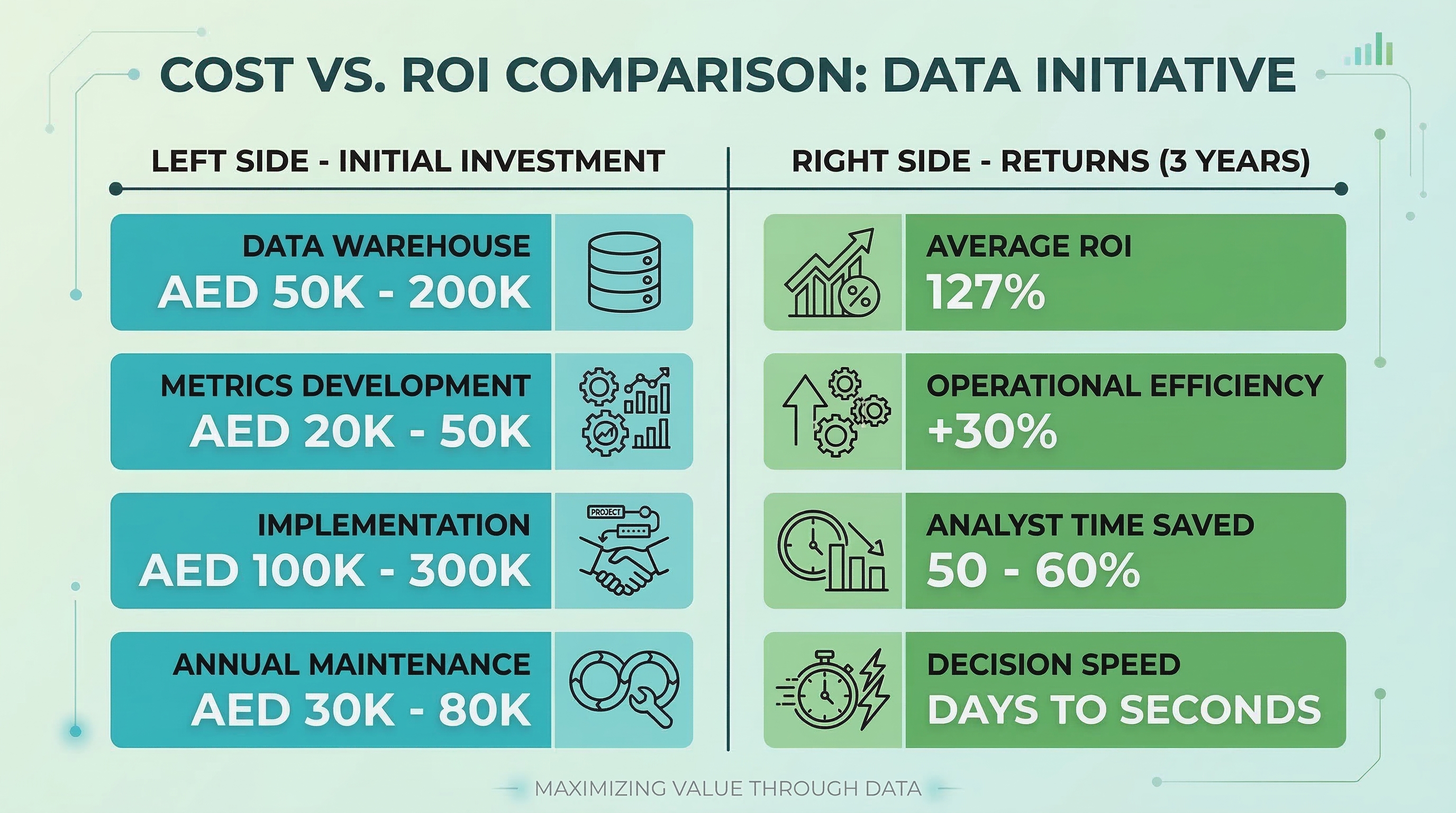
Implementation costs vary widely based on organisation size, existing infrastructure, and whether work is handled internally or externally. As a rough guide:
- Data warehouse setup (if not already in place): AED 50,000 to 200,000
- Metrics dictionary development: AED 20,000 to 50,000
- System implementation: AED 100,000 to 300,000
- Ongoing maintenance and expansion: AED 30,000 to 80,000 annually
These figures assume external expertise for setup and internal staff for ongoing management.
Organisations with BI-driven strategies achieve an average ROI of 127% within 3 years (DataStack Hub, 2025). The investment pays for itself through reduced analyst workload, faster decision-making, and better resource allocation.
Some organisations expect positive ROI in six months or less (CIO, 2026), though this timeline typically applies only when strong foundations already exist.

How to measure success
Implementation is complete when the system operates reliably, but success should be measured by outcomes, not technical milestones.
Usage metrics
Track how many people use the system, how often they use it, and what questions they ask. Growth in usage indicates that the system delivers value. Stagnant usage suggests problems with performance, accuracy, or training.
Target: 30% to 50% of knowledge workers using the system at least weekly within six months of launch.
Analyst workload
Measure how much time data analysts spend answering ad hoc requests before and after implementation. As referenced in Article 1, analysts in fast-paced industries spend 50% to 70% of their time on these requests. Successful implementations reduce this to 20% to 30%.
Target: 50% reduction in analyst time spent on routine data requests within three months of widespread adoption.
Decision latency
Track how long it takes from question to decision for key business processes. As demonstrated in Article 4, decisions that previously required days can happen in hours or minutes when data is immediately accessible.
Target: Measurable reduction in time from question to action for specific decision types (budget approvals, campaign adjustments, hiring decisions).
Data quality improvements
Monitor how many data quality issues get identified and resolved after implementation. Increased visibility drives improvement, but only if issues get tracked and addressed.
Target: 40% reduction in data discrepancies within six months, measured through incident tracking.
Growing the system over time
Initial implementation is not the end state. The system grows as the organisation's needs evolve and as usage patterns emerge.
Adding complexity gradually
Start with simple questions that have straightforward answers. "What was revenue last month?" requires a single calculation from one data source. "How did our customer acquisition cost trend compare to our average order value by marketing channel over the past six quarters?" requires multiple sources, complex calculations, and sophisticated logic.
Build the foundation with simple questions. Add complexity only after users trust the system and understand how to use it effectively.
Learning from usage patterns
Track which questions get asked most frequently. These become priorities for optimisation. Questions that rarely get asked may not warrant the effort to implement perfectly.
Some questions reveal gaps in the metrics dictionary. If users frequently ask about customer lifetime value but the system cannot answer accurately, this signals that the definition needs work or that additional data sources need integration.
Refining based on feedback
Users will identify edge cases where answers seem incorrect. Sometimes the data is wrong. Sometimes the definition is ambiguous. Sometimes the question itself needs clarification.
Each issue provides an opportunity to improve either the data, the definitions, or the user training. Successful implementations treat these issues as learning opportunities rather than failures.
When to get external help
Many organisations can handle parts of implementation internally, but external expertise accelerates specific phases.
Technical implementation
Setting up the infrastructure, configuring security, and building the semantic layer requires specific technical skills. Organisations with strong internal IT teams can manage this. Those without may benefit from external specialists who have implemented similar systems before.
Metrics definition workshops
Getting departments to agree on metric definitions is often more political than technical. External facilitators can help navigate these conversations without getting caught in internal dynamics.
Training and change management
Adoption depends on effective training and ongoing support. External trainers bring experience from multiple implementations and can identify adoption barriers that internal teams might miss.
The Xcelerate Business Analyst implementation includes all these components: technical setup, metrics definition support, security configuration, training, and ongoing optimisation. The approach focuses on delivering value quickly while building foundations that support long-term growth.
What this means for your organisation
The series began with a finance director waiting three days for a revenue figure. It explored what becomes possible when that wait disappears, explained the infrastructure that makes instant answers trustworthy, and showed practical applications across business functions.
This final article has outlined what implementation requires. The work is substantial but not insurmountable. Most mid-sized organisations already have the core components: centralised data storage, basic metric definitions, and people who understand what questions matter.
What they typically lack is the structured approach to connect these pieces into a system that works conversationally. That structure is what implementation provides.
The return on this investment comes in many forms. Analysts spend less time answering routine questions and more time on complex analysis. Business users make decisions based on current data rather than estimates. Strategic planning becomes more responsive because assumptions can be tested quickly.
The question is not whether conversational data access delivers value. The evidence from organisations using these systems demonstrates that it does. The question is whether your organisation is ready to invest the time and resources required to implement it properly.
Next steps
If your organisation experiences the problems described in this series; questions that take too long to answer, decisions made without current data, analysts overwhelmed by ad hoc requests, then conversational data access may address those problems.
The first step is assessment. Where does your data currently reside? What metrics do your teams ask about most frequently? How mature is your data governance? What would rapid data access enable that is currently not possible?
Xcelerate Technologies helps mid-sized businesses answer these questions and build systems that deliver instant, accurate, governed data access. The approach starts with understanding your current state, identifying where immediate value exists, and creating a roadmap that delivers results while building sustainable infrastructure.
The technology exists. The question is whether your organisation is ready to close the gap between having data and being able to use it.
Series recap
This five-part series explored the gap between having data and using it effectively:
- Why a simple revenue question takes three days to answer – The problem: business questions stuck waiting for analysts
- When everyone can ask questions about your data – What changes when data access shifts from queue to self-service
- The infrastructure behind instant answers – How systems translate questions into verified answers without hallucination
- What instant data access looks like in finance, sales, operations, marketing, and HR – Real scenarios showing practical application
- How to implement conversational data access – The roadmap from metrics dictionary to live system
Contact us to discuss implementation.
References
- BARC (2024) BI Survey 17: Success factors in BI software. Available at: https://barc.com/success-factors-bi-software/(Accessed: 18 March 2026).
- CIO (2026) '2026: The year AI ROI gets real', CIO, 7 January. Available at: https://www.cio.com/article/4114010/2026-the-year-ai-roi-gets-real.html (Accessed: 18 March 2026).
- DataStack Hub (2025) Business intelligence statistics. Available at: https://www.datastackhub.com/insights/business-intelligence-statistics/ (Accessed: 18 March 2026).
- ElectroIQ (2025) Data governance statistics. Available at: https://electroiq.com/stats/data-governance/ (Accessed: 18 March 2026).
- Gartner via Atlan (2026) 80% of data and analytics governance initiatives will fail by 2027. Available at: https://atlan.com/gartner-data-governance/ (Accessed: 18 March 2026).
- Hex (2026) State of data teams 2026. Available at: https://hex.tech/state-of-data-teams/ (Accessed: 18 March 2026).
- Integrate.io (2026) Data transformation challenge statistics. Available at: https://www.integrate.io/blog/data-transformation-challenge-statistics/ (Accessed: 18 March 2026).
- LARK InfoLab (2026) 'How long does it take to see results from business intelligence?', 26 February. Available at: https://www.larkinfolab.nl/2026/02/26/how-long-does-it-take-to-see-results-from-business-intelligence/ (Accessed: 18 March 2026).
- Master of Code (2026) AI ROI: Key metrics, calculations, and strategies. Available at: https://masterofcode.com/blog/ai-roi (Accessed: 18 March 2026).
- Promethium (2025) Enterprise AI implementation roadmap and timeline. Available at: https://promethium.ai/guides/enterprise-ai-implementation-roadmap-timeline/ (Accessed: 18 March 2026).
- SR Analytics (2025) Business intelligence trends. Available at: https://sranalytics.io/blog/business-intelligence-trends/(Accessed: 18 March 2026).
- SR Analytics (2026) Business intelligence strategy: Your roadmap to data-driven success. Available at: https://sranalytics.io/blog/business-intelligence-strategy-your-roadmap-to-data-driven-success/ (Accessed: 18 March 2026).